
ECR-C
The Electronic Corner Reflector (ECR) is an active calibration target designed to support the calibration, validation, and long-term performance monitoring of SAR systems. It ensures accurate radar measurements, enabling consistent and reliable mission performance throughout the operational lifecycle.
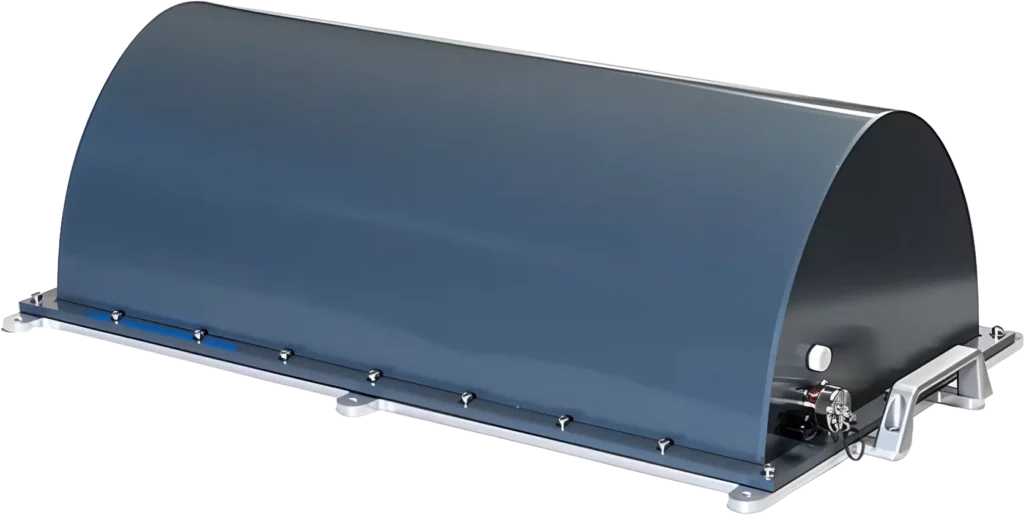
Electronic Corner Reflector (ECR-C)
The ECR-C is a compact, user-deployed active corner reflector that receives, amplifies, and retransmits radar signals from satellites, enabling high-precision measurements of position and displacement for DInSAR analysis.
Unlike traditional passive reflectors, the ECR-C uses an active design, operating only during satellite overpasses and switching to sleep mode between passes. Configuration is simple through a user-friendly control software that manages overpass timing and duration.
It supports applications such as terrain deformation monitoring and atmospheric studies.
Technical data
| Operational frequency | C-band (5.4 GHz) |
| Bandwidth | Up to 100 MHz |
| Vertical displacement measurement | 1 mm |
| Storage | Up to 1000 activation and deactivation times |
| Size | 650 (L) x 400 (W) x 233 (H) mm |
| Weight | 10.7 kg |
Advantages
- A more compact alternative to standard passive corner reflectors, which can be meters in size
- Allows for accurate calibration of satellite radar data, including location and atmospheric data
- Operation frequencies compatible with Sentinel-1A and -1B and RADARSAT-2
Key features
- Control and Configurations with a provided GUI
- GSM/WiFi for remote control
- GPS for clock and position information
- Standard USB connection
- Power Supply: two field-replaceable batteries, solar panels, AC mains
- Polarization: horizontal, vertical (user selectable via software)
- Ascending and descending orbits covered with one transponder (user selectable via software)
Applications
- Satellite Commissioning
- Radiometric Calibration
- Geometric Calibration
- Performance Validation
- Long-Term Monitoring
- Mission Verification
- Research & Testing